The Catalan coast south of Barcelona is one of the most rewarding stretches for sailing in the western Mediterranean. In a journey of just 35 nautical miles — between four and six hours of passage depending on the wind — the scenery shifts from the Barcelona skyline to the coves of the Garraf and, finally, to the arrival at the port of Sitges, one of the most characterful sea entries on the entire Costa Dorada.
This guide is aimed at those considering this route for the first time aboard a charter sailing yacht, whether in skippered mode (with skipper included) or bareboat. We cover the full journey, points of interest, recommended anchorages and the meteorological aspects to consider before setting sail.
Departure point: Puerto Olímpico and Port Vell
The route starts from Puerto Olímpico or Port Vell, Barcelona's two main marinas. Puerto Olímpico has logistical advantages: it is better connected for arriving with your group, has full services and the exit to open sea is more direct heading south. Port Vell, more central, offers the benefit of having the city within reach if you need last-minute provisions.
The first stretch, from either of these points to passing the Llobregat, is coastal navigation with shallow seabed. Attention must be paid to El Prat Airport traffic — flight approaches pass over the coast — and a safe distance must be maintained from river mouths, which after rain can accumulate floating debris.
The Garraf: the first landmark of the route
About 15 miles south of Barcelona, the Garraf massif drops straight to the sea forming a stretch of rugged coastline without beach, with white limestone cliffs that the afternoon sun turns golden. It is one of the most spectacular stretches of the Catalan coast and the one that gives this route its true character.
On this stretch there are two anchorage options worth stopping at:
Cala de Garraf. A small cove with sandy anchorage, sheltered from the north and northeast. Depth 3–5 metres in the inner part. There is a small beach with a seasonal beach bar. Mooring is not possible (anchorage only) and in July and August it can be busy. Outside high season it is peaceful with good underwater visibility.
Puerto de Garraf. Small fishing port with a leisure pontoon. Limited draught (maximum 1.5–2 metres at some points), so long-keel sailing yachts should check availability before entering. Has a bar and restaurant. Ideal for a midday stop.
| Point | Miles from BCN | Stop type | Max. draught |
|---|---|---|---|
| Puerto Olímpico (departure) | 0 | Departure base | 4 m |
| Cala de Garraf | 15 | Anchorage | Free anchorage |
| Puerto de Garraf | 16 | Port / stop | 1,5–2 m |
| Cala Ginesta | 20 | Full marina | 3 m |
| Sitges (Port d'Aiguadolç) | 35 | Final destination | 3,5 m |
Cala Ginesta and the deep Garraf
About 20 miles from Barcelona, Port Ginesta is a reference marina in the Baix Llobregat. With over 1,000 berths, full services, fuel station, nautical supermarket and several restaurants, it is the ideal stop if the passage runs longer than expected or if wind conditions recommend waiting a few hours before continuing to Sitges.
The stretch between Port Ginesta and Sitges — the final 15 miles — runs along the most open coast of the entire route. Here the south and southwest wind has more fetch and this is where sailing conditions are best exploited if the Garbí (southwest wind) is active, which is common on summer afternoons. It is also the stretch where swell can be somewhat more pronounced if there is a headwind.
Arriving at Sitges by sea
Entering Sitges' Port d'Aiguadolç from the north offers one of the most characteristic views of the Costa Dorada: the silhouette of the church of Sant Bartomeu i Santa Tecla on the promontory, the seafront promenade of modernist houses and the white of the buildings against the blue of the Mediterranean. It is an arrival that rewards every effort of the passage.
Port d'Aiguadolç is Sitges' main marina, with all nautical services. It has transit berths that should be reserved in advance in high season (July–August). Sitges town centre is a ten-minute walk from the pontoon.
"Arriving at Sitges by sea, with the church of Sant Bartomeu in the background and the smell of salt from the Garraf in the air, is one of those moments that alone justify the entire passage."
Weather conditions to consider
The Barcelona coast has a fairly predictable wind regime in the summer season. The sea breeze (Marinada) blows from E-NE between 11:00 and 18:00, with strengths of 10 to 18 knots, ideal for sailing close-hauled or on a beam reach. In the afternoon it can freshen slightly. The Garbí (SW) appears less frequently but when it does it can bring 15–25 knots and generate short chop that makes sailing more lively.
North winds (Tramontana and Mestral) are unusual in summer but can appear after the passage of a depression. In spring and autumn weather forecasts are more variable and it is advisable to consult AEMET bulletins 24 hours in advance. Puertos del Estado (www.puertos.es) offers real-time buoy data for the Barcelona coast.
For this route, the ideal windows are summer mornings (departure between 09:00 and 10:00) or spring afternoons (departure between 14:00 and 15:00 when the sea breeze is already established). Avoid midday departures in summer if the wind is calm: engine and heat are not the best combination.
Recommended sailing yachts for this route
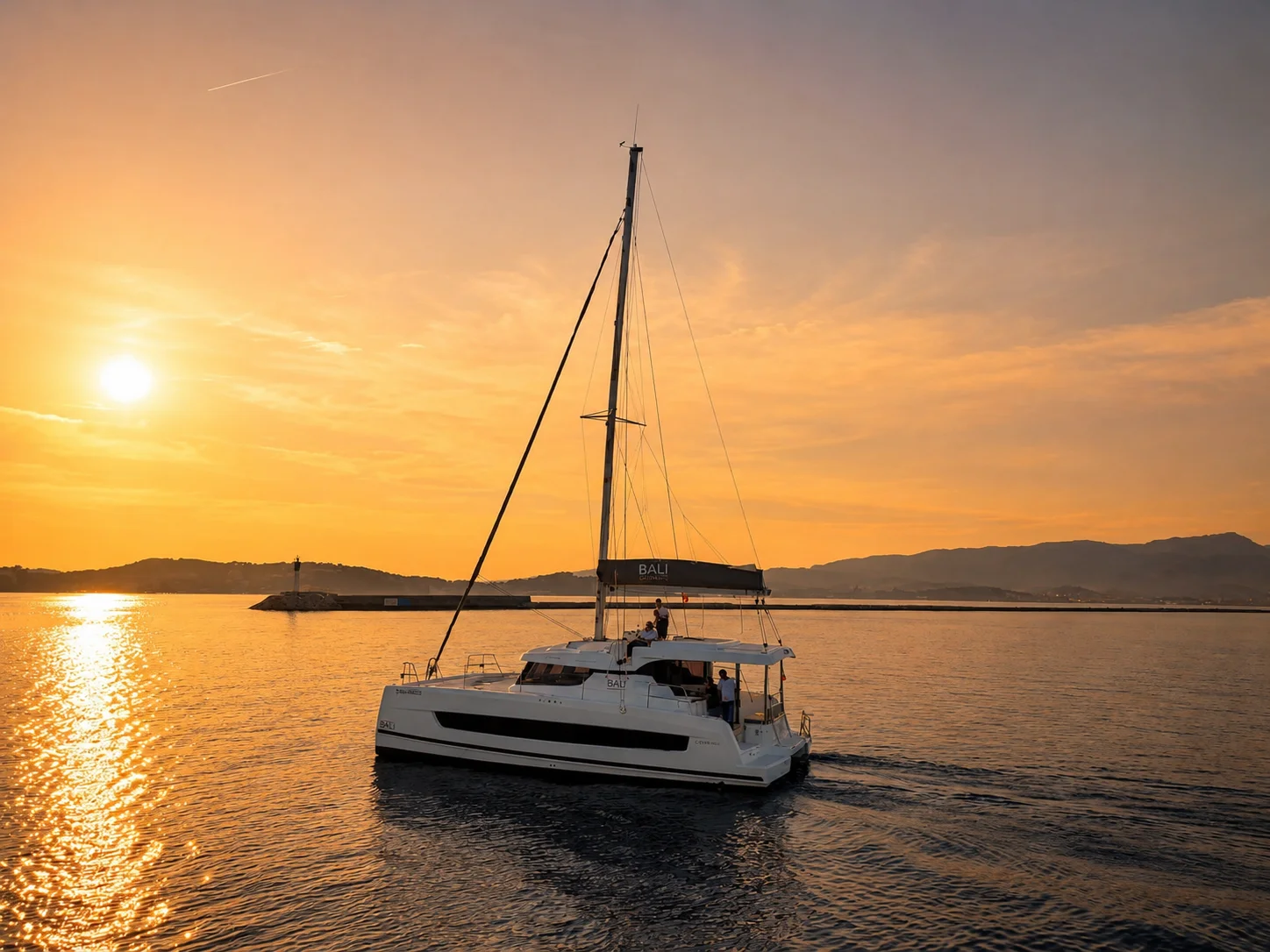
The Barcelona–Sitges route is accessible for sailing yachts from 32 feet, but the most comfortable range for enjoying it in a group is between 38 and 50 feet. A sailing yacht in this range offers sufficient stability in case of Garraf ground swell, comfortable interior space for eating on board and a keel that allows anchoring in the coves without touching the bottom.
In our fleet, the Pardo 43 is the reference sailing yacht for this route. With its 13 metres of LOA, clear deck, spacious cabin and very balanced sail plan, it is capable of making the passage in light conditions at a good pace and is comfortable for both groups of friends and couples seeking privacy on board. The Pardo 43 is a boat that rewards a good sailor without punishing one with fewer sea miles.
The route in private charter format
If the route is booked in skippered mode, the Vértice Experiences skipper handles all navigation and allows crew members to fully enjoy the scenery, swimming at anchor and the arrival at Sitges without worrying about the technical aspects. This mode is especially recommended for groups visiting Barcelona who want a memorable maritime excursion without prior nautical experience.
The full day — including the outbound passage, stop for lunch and swimming at the Garraf anchorage, and afternoon arrival at Sitges — lasts between 7 and 9 hours. The return can be made by train from Sitges to Barcelona (40 minutes, every 30 min) or by private transfer if the group prefers.
Want to do this route?
Check availability of the Pardo 43 or other sailing yachts in our fleet to sail the Barcelona coast. Skipper included or bareboat depending on your experience.
Check Availability